
HIIT
high-intensity interval training, Interval training, sprint training
High-Intensity Interval Training (HIIT) combines short bursts of intense exercise with periods of rest, providing an efficient and effective way to improve fitness in less time.
MoreLess
What is HIIT?
High-Intensity Interval Training, or HIIT, is a fast-paced and powerful workout method that alternates between intense bursts of activity and short recovery periods. Whether you’re looking to improve your cardio, build strength or lose weight, HIIT offers a flexible, time-efficient approach. What’s great about HIIT is that it can be adapted to any fitness level – you don’t need fancy equipment, just a bit of space and some motivation! If you’ve been looking for a way to get fit without spending hours at the gym, HIIT might be the perfect solution. It’s tough, but the results can be amazing, and best of all, workouts can be completed in as little as 20 minutes. Ready to do it? Let’s get started!
Bursts that feature HIIT




Wellbeing benefits
Why HIIT is good for you
HIIT delivers impressive fitness gains, sharper focus and enhanced mood. Quick, intense intervals improve physical health and boost stress management capabilities.
HIIT increases your heart rate quickly, improving heart health and boosting endurance in a shorter amount of time compared to traditional cardio exercises (Gibala et al., 2006).
The high intensity of HIIT workouts helps burn more calories in less time, and the afterburn effect (excess post-exercise oxygen consumption) means you continue to burn calories even after the workout ends (LaForgia et al., 2006).
HIIT often includes bodyweight exercises like squats, lunges and push-ups, which build strength and muscle tone while elevating your heart rate (Paoli et al., 2012).
The short, intense bursts of exercise followed by recovery periods increase your metabolic rate, helping with weight loss and overall energy levels throughout the day (Helgerud et al., 2007).
HIIT is not only good for the body, but it also reduces stress and boosts mood, thanks to the release of endorphins during and after the workout (Harveson et al., 2016).
Common styles
HIIT offers various styles depending on your fitness goals. Here are four popular approaches:
Focuses on high-intensity cardio exercises like sprinting, jumping jacks or cycling to improve heart health and endurance.
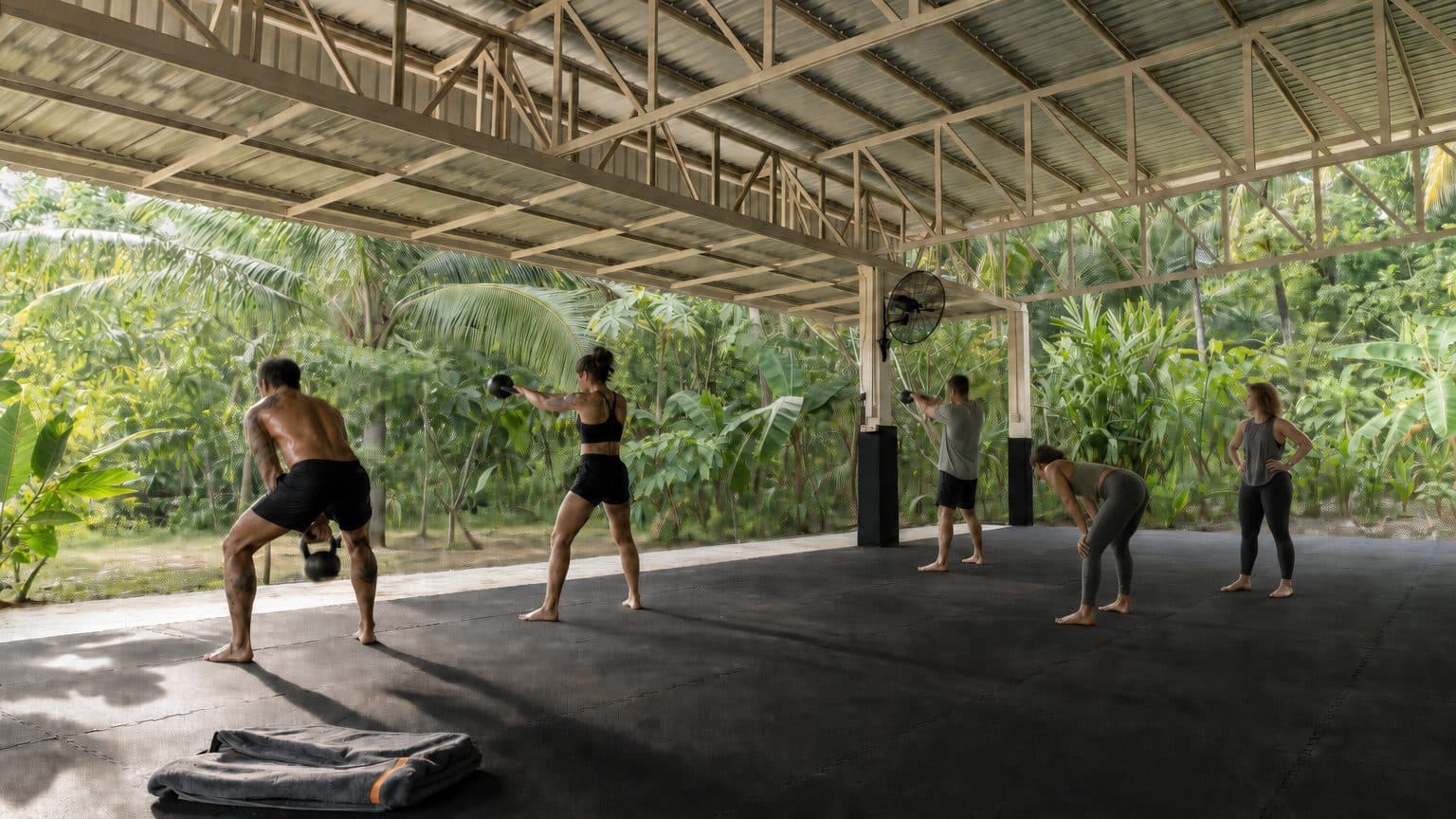
Combines strength training with high-intensity intervals, using dumbbells, kettlebells or resistance bands to build muscle while keeping your heart rate up.
Involves exercises like squats, lunges, push-ups and burpees that rely solely on your bodyweight, making it perfect for at-home or no-equipment workouts.
This style works multiple muscle groups, incorporating both strength and cardio elements for a comprehensive, full-body workout in a short amount of time.
Self-led, one-on-one, or in a group
Whether you go it alone, join a group, or work 1:1 with a teacher, we’ve laid out what each path can look like.
Recommendation for first-timer
1st pick
Ideal for beginners who want flexibility. You can start slow, choose your own pace and try different workouts online.
3rd pick
Perfect for those seeking personalised attention and tailored workouts. A trainer ensures correct form and gradual progression.
2nd pick
Great for those who enjoy structured classes with support. The group atmosphere can be motivating and provide accountability.
Availability
Widely
Accessible anytime through free online videos or subscription apps, allowing you to exercise whenever it suits you.
Moderately
Personal trainers are available by appointment, requiring advance scheduling based on trainer availability.
Moderately
Group classes are offered at set times, either in gyms or virtually. Many gyms offer unlimited HIIT classes with membership.
Average cost per session
Free or low cost
Free to low-cost. Free classes are widely available online, or through subscriptions to apps, which range from $10 to $40 per month.
Moderate costs
1:1 training with a personal trainer is more expensive but provides tailored workouts and direct support.
Moderate costs
Pay-per-class ranges from $10 to $40 depending on the studio, with bundles reducing the price per class. Gym memberships offering HIIT classes range from $30 to $150 per month.
Special equipment required
Some with costs
Most self-led HIIT workouts use bodyweight exercises. Good footwear for impact and movement is essential, and basic equipment like dumbbells or a mat can be added as needed.
None or minimal
Trainers may provide weights, bands or other equipment to help you progress, and good shoes are necessary to protect against injury during high-impact moves.
None or minimal
Classes may require basic equipment like mats or resistance bands, but it’s usually provided in-person. Good footwear is a must for movement-heavy sessions.
Potential for socialisation & community
Mostly solo
Self-led HIIT is typically done alone, but you can join online communities or challenges for motivation.
Social potential
One-on-one sessions focus on your goals, but support from a good trainer over time will provide encouragement and accountability.
Highly social
Group classes offer social interaction, motivation, and a sense of community. HIIT-specific studios often provide a strong community feel.
Safety & skill building
Mixed results
You’ll rely on video instructions and your own research. Without guidance, it’s easy to misjudge form or intensity.
Safe & fast
A trainer will ensure proper form and create a plan that builds your strength and skills safely over time.
Mixed results
Group classes provide an instructor to guide form and pacing, but individual attention is limited in larger classes. Smaller boutique classes may offer more personalised guidance.
Space or privacy required
Minimal
You can do self-led HIIT in a small space like a living room or backyard. No need for much privacy.
Some required
1:1 training may take place at home or in a gym, with more focus on your individual workout needs.
Some required
Group classes are public, whether in-person or virtual, and require a bit more space for movement.
Ease of scheduling
Very flexible
Self-led HIIT can be done anytime, giving you full flexibility over when and how long you train.
Need to plan
Requires advance booking, and flexibility depends on your trainer’s availability.
Need to plan
Classes are scheduled at specific times, whether in-person or virtual, which may not always fit your schedule. Memberships often offer more flexibility with unlimited classes.
Setup time
Little to none
You can start quickly by selecting a video or app and getting into your workout space.
Up to 30 mins
Sessions with a trainer require some setup, whether meeting at a gym or home, and prep for the workout.
Up to 30 mins
You’ll need to arrive at the class or log in on time, with some prep to set up your space or equipment.
Active practice time
Under 20 mins
Self-led sessions vary in length. Most HIIT workouts last around 20-30 minutes, depending on the routine.
Up to an hour
One-on-one sessions usually run about an hour, giving time for both intensity and focused instruction.
Up to an hour
Group classes typically run for 30 to 60 minutes, depending on the type of HIIT and class setup.
Unexpected advantages
Actually useful
Even if you work odd hours, you'll still be able to get high-quality workouts at times that suit you.
Wholesome
Trainers have expert ways of guiding you through the tougher parts of the workout. Hopefully, your trainer also has a great sense of humour up their sleeve and can crack a well-timed joke to keep you motivated.
Wholesome
Joining a group challenge can inspire healthy competition with your workout mates and lead to some surprising (and great) fitness and wellbeing results.
Academic research we rate
- Can high-intensity interval training improve mental health outcomes in the general population and those with physical illnesses? A systematic review and meta-analysis
Full citationHide citation
- Effects of high-intensity interval training on cardiometabolic health: a systematic review and meta-analysis of intervention studies
Full citationHide citation
- The effect of three different exercise training modalities on cognitive and physical function in a healthy older population
Full citationHide citation
- Affective and enjoyment responses in high intensity interval training and continuous training: A systematic review and meta-analysis
Full citationHide citation
- HIGH-INTENSITY INTERVAL TRAINING, SLEEP, AND COGNITION IN OLDER ADULTS: A SYSTEMATIC REVIEW
Full citationHide citation
Show all 10 studiesShow fewer studies
- The Effect of Acute High-Intensity Interval Training on Executive Function: A Systematic Review
Full citationHide citation
- A systematic review and meta-analysis of affective responses to acute high intensity interval exercise compared with continuous moderate- and high-Intensity exercise
Full citationHide citation
- A scoping review of the psychological responses to interval exercise: is interval exercise a viable alternative to traditional exercise?
Full citationHide citation
- Functional High-Intensity Circuit Training Improves Body Composition, Peak Oxygen Uptake, Strength, and Alters Certain Dimensions of Quality of Life in Overweight Women
Full citationHide citation
- Low-Volume High-Intensity Interval Training in a Gym Setting Improves Cardio-Metabolic and Psychological Health
Full citationHide citation
Safety
It's time! You're ready to get your body moving and find a new level. HIIT is safe for most people, and there are different options to choose from when you're getting started to suit your current level. Read on for some important details and get your HIIT experience off to a fantastic start!
- Listen to your body, start gradually and practise with care to minimise risks. If you are pregnant or have a health condition, we recommend consulting with your healthcare provider.
- Begin with a warm up.
- Stop if you experience pain, strong discomfort or dizziness.
- Wear appropriate footwear and stay hydrated.
What you might experience
You’ve decided to try your first HIIT workout, and as you prepare, you’re feeling a bit nervous. Wondering if you’ll be able to handle this is a very valid thought to have! You’ve heard it’s intense, but HIIT is all about pacing yourself. As a beginner, it’s normal to modify the exercises or take extra breaks. The key is to start slow and gradually push yourself.
The workout begins with a burst of effort – squats, jumping jacks or push-ups. It’s challenging, but the short intervals make it manageable. You push through the first few exercises, and although your heart’s racing, you realise you’re getting through it. It’s hard work, but that feeling of accomplishment could start kicking in right away.
Between each set, you get a short rest – just enough to catch your breath. At first, you think it’s not enough time to recover, but that’s the point! HIIT works by pushing you, even during the rest periods. It’s normal to feel breathless, but remember, the intensity is what makes HIIT effective. You’re building endurance with each round.
As the workout progresses, you start to notice the effects – your muscles are burning, and you’re pushing harder than you expected. The intervals can be challenging, but you might also realise how powerful and capable your body is. Even if it’s tough, you’re amazed at how much your body can handle when you stay focused and keep moving.
The workout finally ends, and though you’re sweaty and out of breath, there’s a huge sense of accomplishment. You did it – you pushed through each interval, gave it your all and made it to the end. There’s a good chance a post-workout high will kick in, and have you already thinking about how great it feels to have completed something this intense.
Check it out


Want to try HIIT alongside some other activities?
You don't have to build a routine from scratch. Every Burst is a ready-made plan you can schedule in a couple of taps.