
Tai Chi
tai chi chuan, taiji, taijiquan
Tai Chi is a slow, flowing movement practice that began as a martial art and is now widely used to improve balance, coordination, focus and relaxation.
MoreLess
What is Tai Chi?
Tai Chi is a series of slow, controlled movements that flow from one into the next. It began as a martial art, but most people now come to it as a gentle way to improve balance, coordination, focus and relaxation.
A class usually involves learning short sequences of movements, shifting your weight carefully, and paying attention to posture, breathing and timing. It can look simple from the outside, but doing it well takes more concentration and body control than many beginners expect.
You do not need to be especially fit or flexible to start. Tai Chi is commonly taught in a way that makes it accessible for different ages and fitness levels, and many classes focus more on health and movement than martial arts technique.
You are unlikely to leave drenched in sweat, but you may notice your legs working, your balance being tested, and your mind needing to stay on what you are doing. That mix of slow movement and concentration is a big part of what draws people to it.
Curious what your first Tai Chi class might be like? Read on.
Bursts that feature tai chi
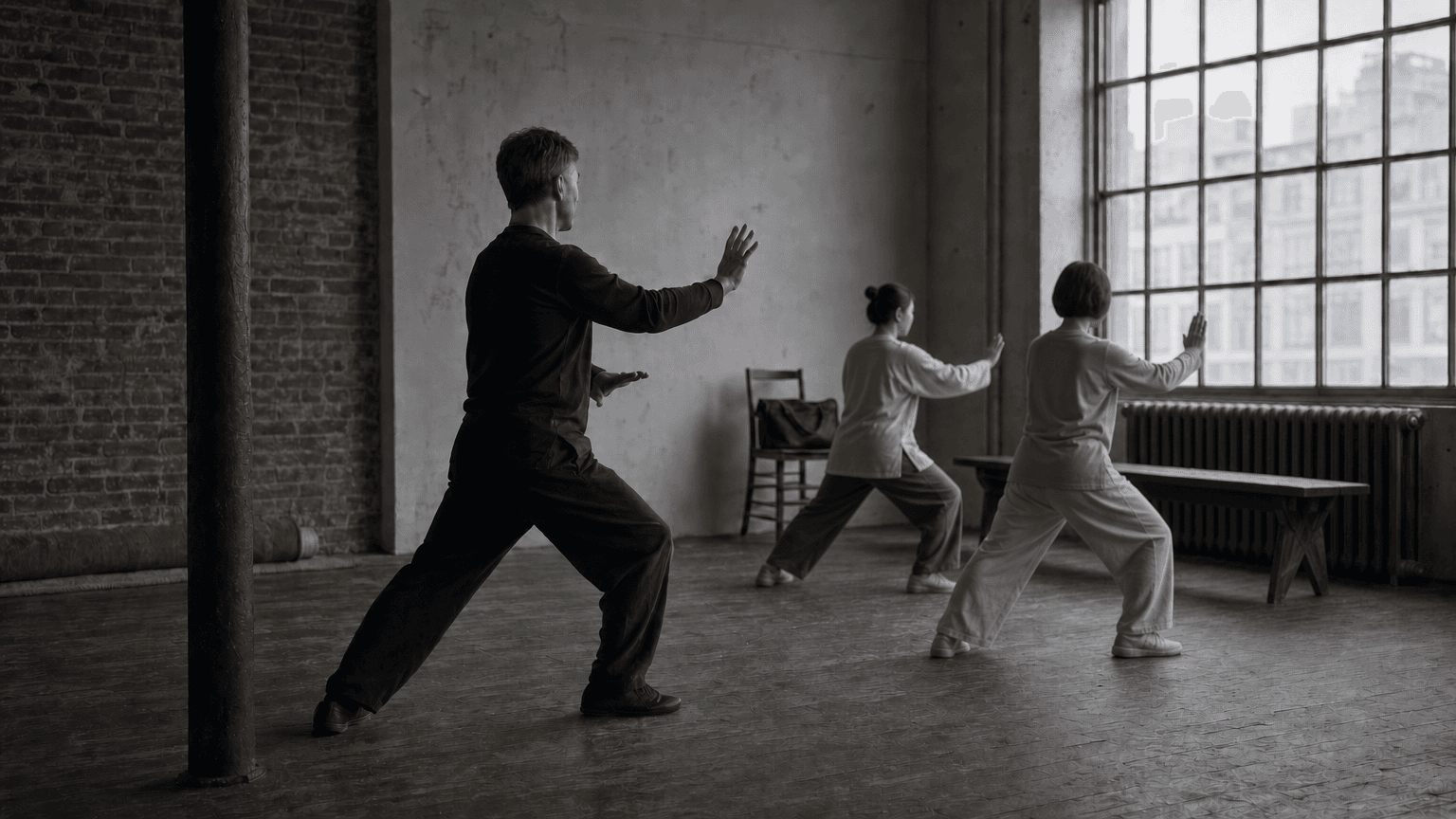
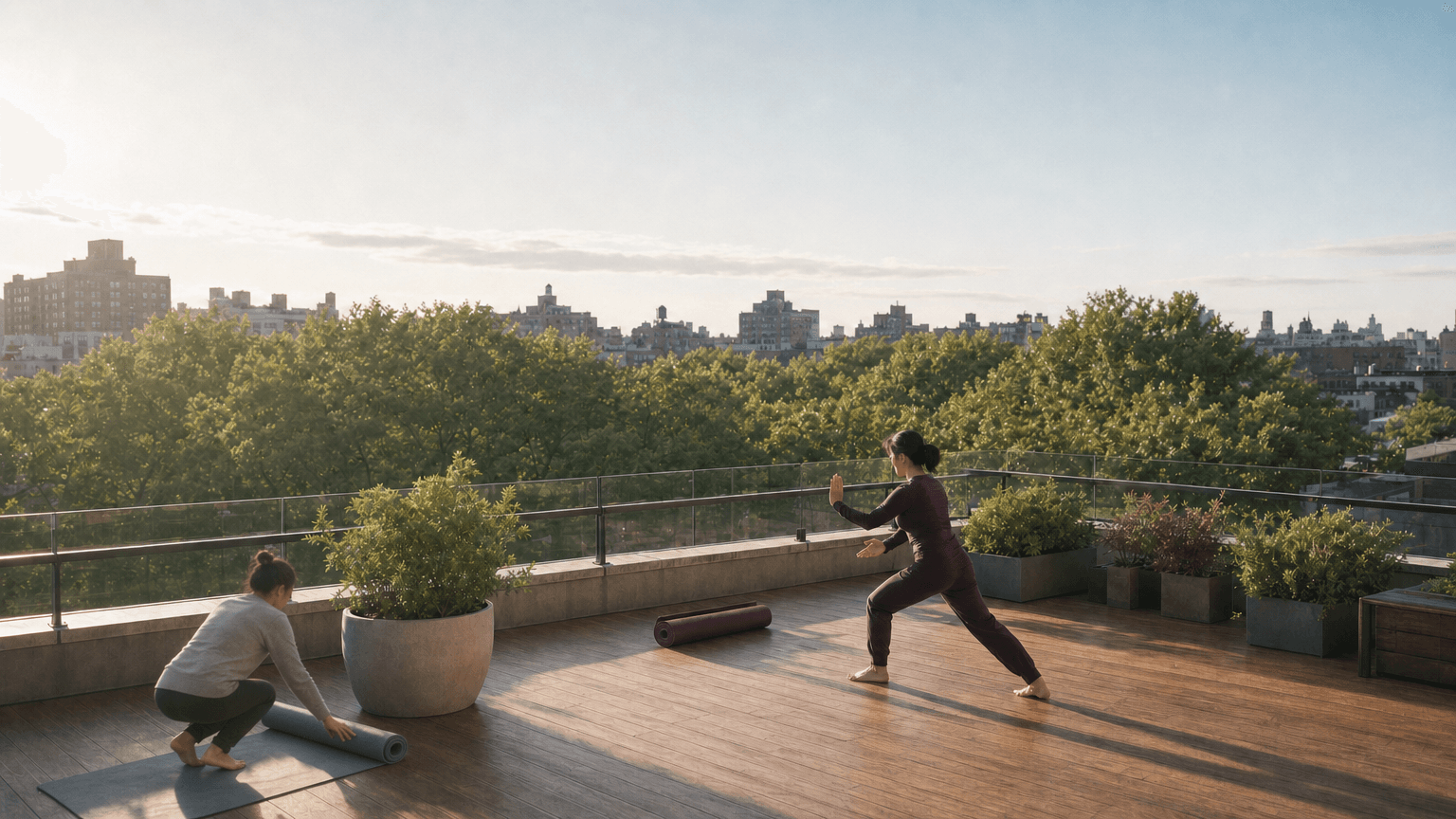
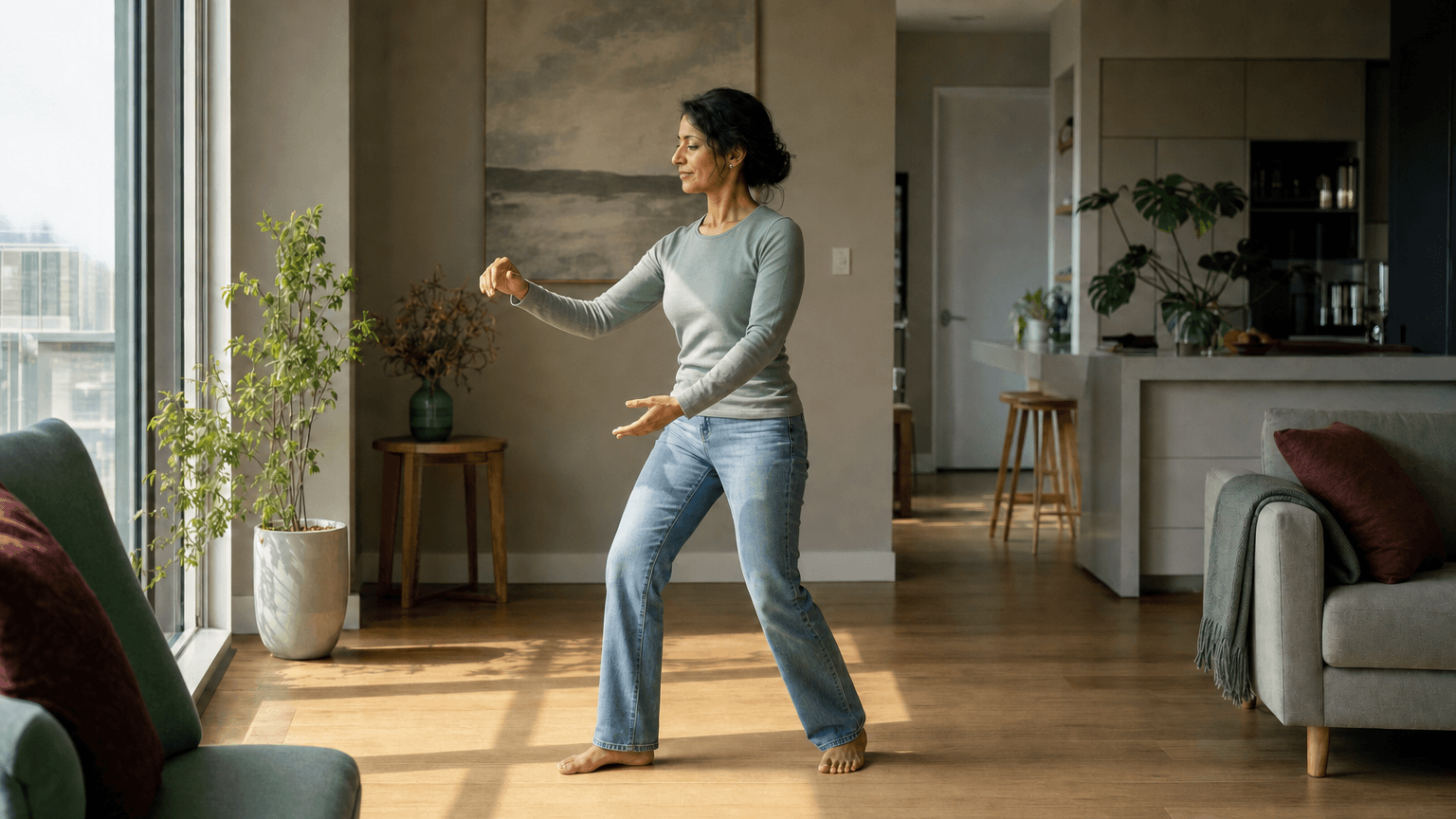
Wellbeing benefits
Why Tai Chi is good for you
Tai Chi can improve balance, coordination, and confidence in how you move. With regular practice, you may also notice better sleep and a calmer mind.
Meta-analyses found that Tai Chi improved task-switching and other executive-function skills, which supports the kind of mental flexibility involved in creative thinking (Zheng et al., 2015; Chen et al., 2021).
Reviews of Tai Chi found small but meaningful improvements in depressive symptoms and mental quality of life, suggesting the practice may help people tune into internal sensations and recognise their emotional state more clearly (Choo et al., 2020; Zhao et al., 2021).
A meta-analysis found that Tai Chi improved heart rate variability, which suggests the practice may help the nervous system shift more easily into a restful state and support physical recovery after stress or effort (Zou et al., 2018).
A review of 16 trials found that Tai Chi improved heart rate variability and reduced perceived stress, suggesting it can help people stay steadier under pressure and recover more effectively when stress builds (Zou et al., 2018).
A meta-analysis found small but consistent improvements in the vitality part of quality-of-life surveys for people practising Tai Chi, suggesting it may help support a greater sense of energy and physical wellbeing (Choo et al., 2020).
Common styles
As you explore Tai Chi, you’ll notice that different styles are taught in slightly different ways. Some use larger, slower movements, while others are more compact or physically demanding. Here are a few of the main styles you’re likely to come across:
This is the most widely practised form of Tai Chi. Yang style is known for slow, flowing movements and a more open shape, which is one reason it is often recommended for beginners.
Chen is the oldest Tai Chi style and has a stronger martial arts feel than the others. It combines slow, controlled movements with bursts of speed and lower stances, so it can feel more demanding physically.
Sun style uses higher stances and smoother steps, which can make it feel easier on the joints. It is often chosen by older adults or people looking for a lighter way to get started.
Wu style uses smaller, more compact movements and puts a lot of attention on balance and control. It can look more subtle from the outside, but still takes concentration to do well.
Self-led, one-on-one, or in a group
Whether you go it alone, join a group, or work 1:1 with a teacher, we’ve laid out what each path can look like.
Recommendation for first-timer
2nd pick
A realistic option if you want to start at home and go at your own pace. Many people can follow a basic online guide, but it is still easier to learn the movements well with a teacher in the room.
3rd pick
This is less common as a starting point, but it can be a good choice if you have a specific goal, want more individual guidance, or need the practice adapted to suit you.
1st pick
This is usually the best place to start. A live class gives you structure, a clearer sense of the pace, and a teacher who can guide the movements as you learn.
Availability
Widely
There is a lot of beginner content online, so it is easy to get started at home or outdoors.
Moderately
1:1 teaching is available, but it may take more effort to find the right teacher and time that suits.
Widely
Beginner-friendly Tai Chi classes are fairly easy to find through community centres, gyms, and local groups.
Average cost per session
Free or low cost
Often free or very low-cost. Some videos or apps may require a small one-off payment or subscription.
Expensive
Private sessions usually cost more, especially with experienced teachers or if travel is involved.
Free or low cost
Group classes are usually affordable, especially those run through community centres, clubs or local groups.
Special equipment required
None or minimal
No special equipment is needed. Comfortable clothing and a bit of space are usually enough.
None or minimal
No special equipment is needed for 1:1 sessions either. If it is online, you just need enough space to move comfortably.
None or minimal
Group classes are usually equipment-free. Comfortable clothing is usually all you need.
Potential for socialisation & community
Mostly solo
Doing it on your own means missing the shared class environment and the connection that can come from practising with other people.
Mostly solo
Less social, but sessions often include time to reflect, share or check in with your teacher.
Highly social
Practising in a group can build a sense of connection and shared experience over time.
Safety & skill building
Mixed results
Online guides are improving, but without feedback, it’s harder to correct posture or movement errors.
Safe & fast
A strong option if you want more tailored guidance or need the practice adapted to suit you.
Mixed results
Instructors can watch for safety, adjust your form, and explain the movements clearly.
Space or privacy required
Some required
You can practise in a small indoor space or outside if you have enough room to move comfortably.
Some required
1:1 sessions usually give you more privacy, whether they are held at home, in a studio, or online.
Some required
Classes are usually held in shared spaces, so privacy is limited.
Ease of scheduling
Very flexible
You can fit self-led practice around your own schedule.
Need to plan
You need to book ahead.
Need to plan
Group classes run at set times, so you need to work around the class schedule.
Setup time
Little to none
You usually just need to check clothing let’s you move, make a bit of space, and begin.
Up to 30 mins
Setting up for a lesson will only take a few moments, the instructor will guide you through the process. Add extra if you need to travel.
Up to 30 mins
Just factor in travel time and settling in before class.
Active practice time
Up to 30 mins
Short, flexible sessions are common. You can also repeat sequences as needed.
An hour +
1:1 sessions may go deeper and take more time, depending on your level and goals.
Over 30 mins
Group classes usually run for 45–60 minutes. You might want to allow a little extra if you enjoy socialising before or after a class.
Unexpected advantages
Random
You can revisit the same lesson as many times as you like, taking your time to build skill and strength in moves.
Actually useful
1:1 sessions give you more space to slow things down, ask questions, and work on the parts that are not clicking yet.
Wholesome
You might meet more people in your neighbourhood and expand your social circle through varied age groups.
Academic research we rate
- The effects of sitting Tai Chi on physical and psychosocial health outcomes among individuals with impaired physical mobility: A systematic review and meta-analysis.
Full citationHide citation
- Effectiveness of Tai Chi on quality of life, depressive symptoms and physical function among community-dwelling older adults with chronic disease: A systematic review and meta-analysis.
Full citationHide citation
- An evidence map of the effect of Tai Chi on health outcomes
Full citationHide citation
- The Neurophysiological and Psychological Mechanisms of Qigong as a Treatment for Depression: A Systematic Review and Meta-Analysis
Full citationHide citation
- Dose-Response Association of Tai Chi and Cognition among Community-Dwelling Older Adults: A Systematic Review and Meta-Analysis
Full citationHide citation
Show all 10 studiesShow fewer studies
- Tai Chi and the Protection of Cognitive Ability: A Systematic Review of Prospective Studies in Healthy Adults.
Full citationHide citation
- The Effect of Tai Chi Chuan on Negative Emotions in Non-Clinical Populations: A Meta-Analysis and Systematic Review
Full citationHide citation
- Tai Chi Exercise for Mental and Physical Well-Being in Patients with Depressive Symptoms: A Systematic Review and Meta-Analysis
Full citationHide citation
- The Effects of Qigong on Anxiety, Depression, and Psychological Well-Being: A Systematic Review and Meta-Analysis
Full citationHide citation
- Effects of Mind–Body Exercises (Tai Chi/Yoga) on Heart Rate Variability Parameters and Perceived Stress: A Systematic Review with Meta-Analysis of Randomized Controlled Trials
Full citationHide citation
Safety
You might be getting ready for your first Tai Chi class, or just wondering what that first step looks like. Before you begin, there are a few useful things to know. Tai Chi can look simple from the outside, but it often feels more unfamiliar and demanding than people expect at first. This section will give you a better sense of what to expect and how to start safely.
- Listen to your body, start gradually and practise with care to minimise risks. If you are pregnant or have a health condition, we recommend consulting with your healthcare provider.
What you might experience
You arrive at your first Tai Chi class and notice that everyone else seems to know the pace of it. They move quietly, without rushing, and you may feel a bit unsure of where to stand or what to do first. That feeling is normal when you are new.
The class begins, and the movements look simple at first. Then you realise there is a lot to keep track of, where your feet go, what your hands are doing, and when your weight is meant to shift. It can take more concentration than you expected.
You try to follow along, but your balance wobbles or one part of your body seems to be doing something different from the rest. Tai Chi can feel awkward at first, especially when everyone else looks so settled in what they are doing.
As the session goes on, you may start to notice your thighs, calves, or hips working more than expected. Moving slowly and holding positions can be more demanding than it looks from the outside.
At some point, one movement starts to make more sense. You are still thinking your way through it, but you feel a little less lost than you did at the start. That is usually enough for a first class.
What Tai Chi looks like


Want to try tai chi alongside some other activities?
You don't have to build a routine from scratch. Every Burst is a ready-made plan you can schedule in a couple of taps.