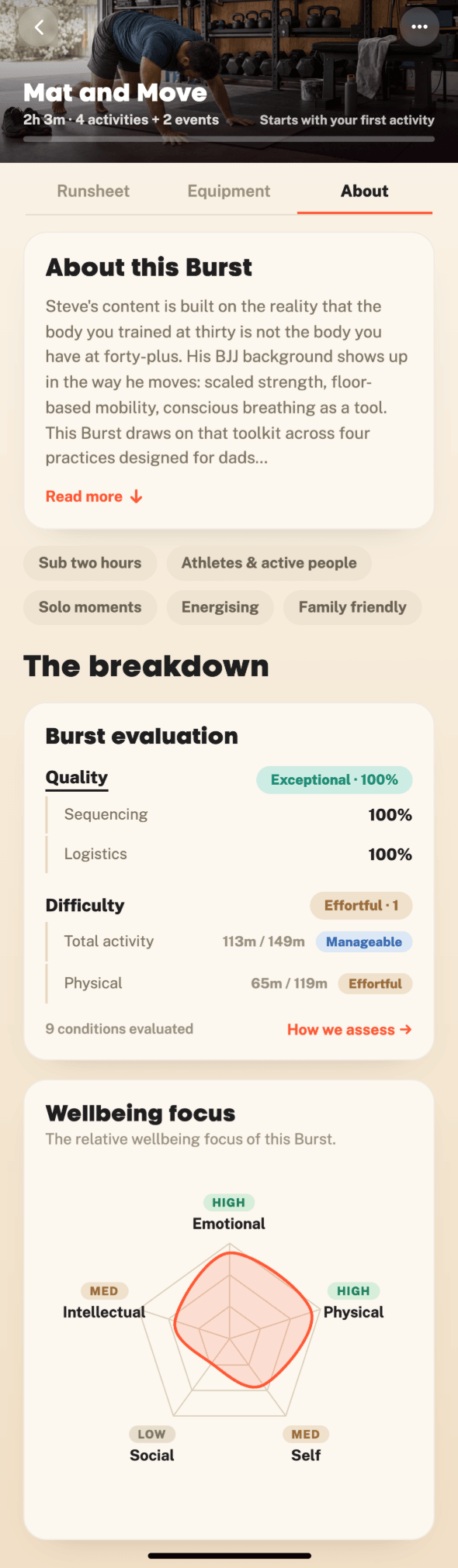
Every Burst is assessed. Here's what we check.
The activities are researched in depth. What we assess is how they are put together: the order, the timing and the durations. Our engine draws on 2,401 assessed activity pairings and 467 reviewed studies to check exactly that.
What are the two scores?
Every Burst gets a quality score and a difficulty rating.
On the Burst card, they're shown together in one easy-to-read label, so you can quickly get a feel for what you're choosing. Behind those two scores is our assessment work, along with a growing pool of real data from completed Bursts. They measure different things, and together give you a quick snapshot of the Burst's quality and difficulty.
This shows you how well the Burst is put together. It takes into account the sequencing and the logistics. Higher is always better.
This lets you know how demanding a Burst is likely to feel. A gentle Burst and a difficult one can both score highly on quality, so this helps you choose the level of effort that feels right for you.

The first score · Quality
Quality: what makes one Burst better put together than another?
The quality score looks at the things you would rarely see assessed in a routine: whether the activities work well together, whether the timing makes sense, and whether the setup, transitions and breaks have been properly considered.
Are the activities in the right order?
There are 120 ways to sequence 5 activities. With 10, there are 3.6 million. Our engine assesses every pair of consecutive activities and how well they work together.
Stretching after resistance training can help recovery. Creative expression after meditation can help concentration. The engine recognises which activities work better together.
Intense physical activity right after mindful eating, or deep introspection straight after high-energy cardio. The engine flags these so they can be avoided or buffered.
Every pairing across 46 activities, plus setup, rest and transitions, has been rated. That includes what works after higher-intensity activities and how to move between physical and mental ones.
Will it all work in practice?
A good sequence still needs to hold together when you do it. The logistics assessment checks whether the timing is realistic, including setup, transitions, activity length and breaks.
Each activity needs enough time to setup, and close down so you can move into what comes next. We check that those transitions are built in, rather than expecting you to jump straight from one activity to another.
We check whether each activity is long enough to be worthwhile without becoming unnecessarily long. A 3-minute meditation may not justify the setup, while a 90-minute one in the middle of a Burst may be unrealistic.
Longer Bursts also need proper breaks. We check for stretches that run too long without a pause or time to eat, because that can affect your energy and focus.
Most Bursts in the library sit at Good or above. A lower score doesn't mean the Burst won't be enjoyable. It means the engine spotted areas where the structure could be stronger. Your experience may still be great; it just hasn't been optimised in the ways the engine looks for.
The second score · Difficulty
Difficulty: how demanding is this Burst likely to feel?
Difficulty is separate from quality. The difficulty rating helps you choose based on your available energy, your experience levels and how much you want to push yourself.
You're always in control once you start. You can shorten an activity, skip something or take a longer break. The rating tells you how demanding the Burst was designed to be, not how you have to do it.
We look at six different types of demand across every Burst. Each one is rated separately, and the overall difficulty rating reflects the hardest point in the experience.
Longer individual sessions can be harder to sustain. A 15-minute yoga session feels different to a 60-minute one.
How much active time is packed into the Burst overall. Five hours of activity is a much bigger ask than 90 minutes.
How much of the Burst involves physically demanding activities like HIIT, resistance training and cardio.
How much sustained attention is required, through activities like meditation and breath counting. It can be demanding in a very different way.
How much inward reflection is involved, through activities like journaling and self-guided inquiry. This can be emotionally demanding.
How much sustained creative effort is involved, through activities like making music or visual art. That can take more out of you than you might expect.
Longer individual sessions can be harder to sustain. A 15-minute yoga session feels different to a 60-minute one.
How much active time is packed into the Burst overall. Five hours of activity is a much bigger ask than 90 minutes.
How much of the Burst involves physically demanding activities like HIIT, resistance training and cardio.
How much sustained attention is required, through activities like meditation and breath counting. It can be demanding in a very different way.
How much inward reflection is involved, through activities like journaling and self-guided inquiry. This can be emotionally demanding.
How much sustained creative effort is involved, through activities like making music or visual art. That can take more out of you than you might expect.
What the difficulty level and number tell you
Gentle, Manageable, Effortful, Demanding or Very difficult is set by the most demanding part of the Burst. In climbing, this is called the crux: the hardest move, and the part the route is rated on. The same idea applies here.
The number adds more context. It reflects how much difficulty builds up across all six areas we assess. A Very difficult · 1 has one major crux and not much else, while a Very difficult · 12 means the difficulty is showing up again and again across the Burst. Gentle and Manageable Bursts don't carry a number.
One thing worth knowing: the difficulty rating is calibrated for a healthy adult who may not be experienced in all the listed activities. If you already do HIIT three times a week, a Burst rated Demanding for physical intensity might feel easier to you. If you've never tried breath work, a Manageable Burst might feel harder than expected. The rating is a useful guide, not a guarantee.
Neither low nor high difficulty is better. A gentle Burst after a hard week might be exactly what you need; a demanding one when you're feeling strong might be exactly what you want. Either way, you can always adjust as you go. A Burst is meant to give you guidance and structure, not pressure to follow it rigidly.
The short version
Two scores, backed by a lot of work.
Every Burst is assessed for sequencing, logistics and difficulty across six areas, drawing on 2,401 assessed activity pairings and a growing pool of data from completed Bursts. And the same depth of work sits behind the 1,164+ activity guides across Bearmore.
The scores are there to make choosing easier. Browse the full library, find one that feels right for you and lock it in.
Browse Bursts